MRI scans, X-rays and other operations after All-on-6
Once you have implants, other parts of your healthcare need to know about them. Here is what titanium implants mean for scans, surgery and anaesthesia, and what to tell staff.
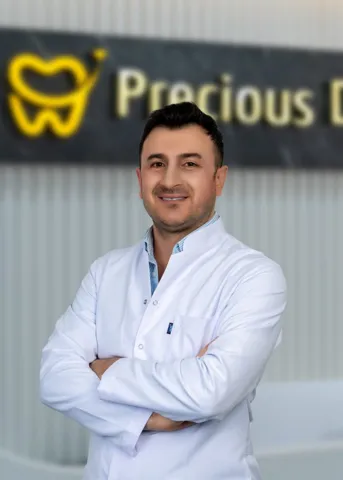 Medically reviewed by Dt. Hüseyin Yavuz Özbek, implant surgeon · Updated October 2026
Titanium dental implants are not magnetic and do not normally stop you having an MRI scan, but you should always tell the radiographer about them. The NHS lists metal parts such as dental fillings and bridges among the things to mention before an MRI. Titanium can blur MRI and CT images near the mouth, which matters for scans of the head and neck. For other surgery, tell the anaesthetist you have a fixed implant bridge, so they can take care when managing your airway.
Why other health professionals need to know
All-on-6 leaves you with six titanium implants in your jaw and, usually, a titanium framework inside the bridge. These don't affect daily life, but they do matter in a few medical situations: scans, operations and dental work by someone who did not place them. The simplest protection is information. Keep your implant passport and a short note of your treatment with your medical records, and mention your implants whenever you are asked about metal in your body.
MRI scans
MRI uses a powerful magnet. Metal that is magnetic can be dangerous in an MRI scanner, which is why staff ask so carefully about metal before a scan. The NHS page on MRI scans lists metal parts in the body, such as surgical clips, a pacemaker, dental fillings or bridges, among the things you should tell the hospital about.
Dental implants are made of titanium or titanium alloys, which are not magnetic in the way iron or steel is. Having implants does not usually stop you having an MRI, but you should still always tell the radiographer, who will make the final decision. If you have other metal implants or devices, those may matter more than your dental implants.
Image quality
Titanium can distort MRI images near it. A 2019 laboratory study found that titanium implants produced very large artefacts, with the measured implant volume many times larger than its real size, while ceramic implants were displayed with little distortion. Another 2019 study compared titanium and zirconium-based implants on MRI, CT and CBCT. In practice this matters for scans of the jaw, face, sinuses and sometimes the brain. For scans of other parts of the body, dental implants are far from the area being imaged and unlikely to matter. Tell the radiographer in advance; they can sometimes adjust the technique.
CT scans and X-rays
CT scans and ordinary X-rays are not affected by magnetism, so implants are not a safety issue. Metal does create bright streaks on CT images near the implants, which can make it harder to see nearby structures in the jaw or face. Dental X-rays are used routinely to check implants, and your dentist will compare them over time. CBCT scans, the 3D scans used to plan implants, can also show streak artefacts around titanium.
Other operations and anaesthesia
If you need a general anaesthetic for any operation, the anaesthetist may place a breathing tube or airway device through your mouth. With a removable denture, you would simply take it out. A fixed All-on-6 bridge stays in place, so:
- tell the anaesthetist at your pre-operative assessment that you have a fixed implant bridge,
- mention which jaw or jaws, and what the teeth are made of,
- mention any loose screws or chips you know about.
This lets them take care to protect the bridge. Bridges are strong, but a knock from an instrument could chip a tooth.
If another surgeon wants to know whether you need antibiotics because of your implants, there is no routine recommendation to give antibiotics simply because someone has dental implants. Decisions about antibiotics depend on the operation and your health.
Dental treatment by another dentist
Any dentist who treats you should know about your implants, especially if you were treated abroad. Bring:
- your implant passport, with the brand, type and size of each implant and the abutments,
- copies of your X-rays and scans,
- details of the bridge material and how it is fixed.
This helps them maintain or repair the bridge with compatible parts. See maintenance visits and the parts of an All-on-6 bridge.
Airport security
People often ask whether implants will set off airport scanners. We have not found good research on dental implants and airport security specifically, so we won't claim a definite answer. Dental implants are small, and security staff deal with medical implants such as joint replacements every day. If you are worried, carrying your implant passport is a reasonable precaution.
Radiotherapy
If you ever need radiotherapy to the head or neck, tell the oncology team about your implants early. Metal can affect radiotherapy planning, and the health of the mouth during and after radiotherapy needs careful management. See All-on-6 after cancer treatment.
If you choose metal-free implants
People who expect to need frequent head and neck MRI scans sometimes ask about ceramic (zirconia) implants, which cause fewer MRI artefacts. They have a smaller evidence base for full-arch bridges. Discuss the trade-offs with your dentist. Our article on titanium allergy covers ceramic implants too.
A simple checklist
- Keep your implant passport with your medical documents.
- Add “dental implants (titanium), fixed full-arch bridge” to any medical history form.
- Tell radiographers before MRI and CT scans of the head and neck.
- Tell anaesthetists before any general anaesthetic.
- Tell any new dentist, and bring your records.
Dental X-rays after All-on-6
Dental X-rays are the main way your implants are monitored over the years. A small X-ray of each implant, or a panoramic X-ray of the whole jaw, shows the bone level around each implant. Comparing these images over time shows whether bone is stable or being lost. Titanium shows up bright white on X-rays, which is helpful: the outline of each implant is clear, and the bone around it can be measured. Your dentist will advise how often X-rays are needed, based on your risk. See maintenance visits.
Hospital admissions
If you are admitted to hospital, especially as an emergency, staff may not know about your implants unless you or a family member tells them. Fixed teeth look natural, and a busy team may assume they are your own. This rarely matters, but it can be relevant for anaesthesia, mouth care on the ward, and any scans of the head. It is worth making sure a family member knows you have implants and where your records are kept.
Mouth care in hospital or care
If you are unwell for some time, mouth care can slip. Plaque builds up quickly under a fixed bridge if it is not cleaned, which raises the risk of inflammation around implants. If you are in hospital or a care setting, ask whether staff can help with cleaning, or ask a family member to bring your water flosser and brushes. Our article on when cleaning is harder has practical advice for carers.
Other medical procedures
- Endoscopy: tell the team about your fixed bridge; a mouthguard may be used to protect it.
- Electrical treatments near the face: mention metal implants to the practitioner.
- Joint replacement and other surgery: keep your mouth healthy beforehand; surgeons often ask about dental infections before major operations.
Keeping your records handy
A phone photo of your implant passport and a note in your phone's medical ID, listing “titanium dental implants, fixed full-arch bridge”, mean the information is with you wherever you are.
Dental work elsewhere in the mouth
If you still have natural teeth in the other jaw, routine dental treatment continues as normal. Tell the dentist about your implant bridge, so they can take care around it and check it at the same visit.
At Precious Dental you leave with an implant passport listing your implants, plus copies of your X-rays and scans. Why Precious Dental.
Common questions
Can I have an MRI with dental implants?
Usually yes. Titanium is not magnetic. Tell the radiographer about your implants and bridge before the scan, as the NHS advises for any metal parts in the body.
Will my implants affect the MRI images?
They can cause blurring or artefacts near the mouth, which matters most for scans of the jaw, face or brain. Studies show titanium causes larger artefacts than ceramic implants. The radiographer can sometimes adjust the scan.
Do implants set off airport scanners?
We are not aware of good evidence on this specific question. Small dental implants are unlikely to cause problems, and security staff deal with medical implants routinely. Carrying your implant passport does no harm.
Do I need antibiotics before other surgery because I have implants?
This is not routinely needed simply because you have dental implants. Your surgeon or doctor will decide based on the operation and your health.
Should I tell my anaesthetist about my bridge?
Yes. A fixed bridge cannot be removed before an operation the way a denture can. The anaesthetist will want to protect it when placing airway devices.
Sources
- NHS — MRI scan (tell staff about metal parts such as dental fillings or bridges)
- Geibel et al. (2019), RöFo — Artifact properties of dental ceramic and titanium implants in MRI
- Artifacts from titanium, zirconium and titanium-zirconium implants on MRI, CT and CBCT: phantom study (2019), Oral Surg Oral Med Oral Pathol Oral Radiol
- British Society of Periodontology — Patient FAQs: dental implants (titanium or ceramic)
Checked October 2026. Where we give our own view as a clinic, we say so.
Ask a dentist-led team, without the sales pitch.
Tell us what you're considering. A real person replies in plain English, and will tell you honestly if All-on-6 isn't the right step for you.