Zygomatic implants: when All-on-6 isn't possible in the upper jaw
If years without teeth have left very little bone in the upper jaw, standard implants may have nothing to hold. Zygomatic implants are one way around that.
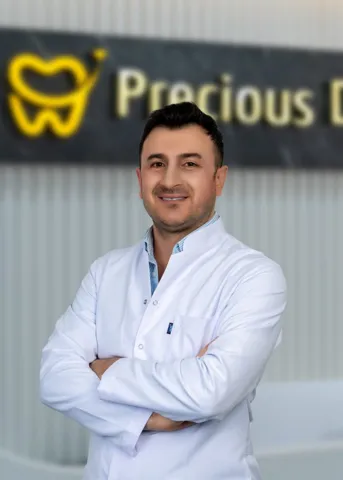 Medically reviewed by Dt. Hüseyin Yavuz Özbek, implant surgeon · Updated October 2026
Zygomatic implants are long implants that run from the back of the upper jaw up into the cheekbone (zygoma), which keeps its bone even when the jaw has shrunk. They can support a fixed full-arch bridge without bone grafting. A 2013 systematic review of 42 studies reported 96.7% cumulative survival over 12 years, with complications including sinusitis, soft-tissue infection and numbness. It is specialist surgery and is not needed by most people.
Why upper-jaw bone runs out
After teeth are lost, the bone that held them gradually shrinks, because nothing is stimulating it any more. In the upper jaw two things make this worse: the bone is often softer than in the lower jaw, and the maxillary sinuses, the air spaces behind the cheeks, can expand downwards into the space where the back teeth used to be. After many years of dentures, there may be only a few millimetres of bone left.
Standard All-on-6 needs enough bone to hold six implants along the arch. When that bone is not there, there are three main routes: add bone (grafting and sinus lift), use fewer, tilted implants such as All-on-4 to avoid the thin areas, or anchor somewhere else. Zygomatic implants are the “somewhere else”.
How zygomatic implants work
A zygomatic implant is much longer than a standard implant, typically several centimetres. It enters the mouth at the back of the upper jaw, passes alongside or through the sinus, and anchors in the zygoma, the cheekbone, which keeps its density even when the jaw has shrunk. Usually two are placed on each side (“quad zygoma”) or one on each side combined with standard implants at the front, and a fixed full-arch bridge is attached to them.
What the research shows
The evidence is mostly from case series rather than trials. A 2013 systematic review of 42 studies calculated a cumulative survival rate of 96.7% over 12 years. Most failures were found by around six months after surgery. The same review recorded 70 cases of sinusitis, 48 soft-tissue infections, 15 cases of altered sensation and 17 openings between the mouth and the sinus (oroantral fistula), and warned these may be under-reported. A later review of quad zygomatic implants (2021) also reported high survival alongside similar complications. The authors of both called for better-designed studies.
Possible complications
- Sinusitis: the most often reported problem, sometimes needing treatment from an ear, nose and throat specialist.
- Soft-tissue infection around where the implant enters the mouth.
- Numbness or tingling of the cheek or lip, usually temporary.
- Oroantral fistula: an opening between the mouth and sinus that may need repair.
- Bridge design: the implants emerge further towards the palate, so the bridge can feel bulkier and be harder to clean. Ask to see examples.
Zygomatic implants or grafting
| Bone graft and sinus lift, then implants | Zygomatic implants | |
|---|---|---|
| Number of surgeries | Often two or more, months apart | Usually one |
| Time to fixed teeth | Longer: graft must heal first | Often fixed teeth soon after surgery |
| Surgery complexity | Moderate, widely performed | High, specialist surgeons |
| Anaesthetic | Often local, sometimes with sedation | Often sedation or general anaesthetic |
| Evidence base | Large | Smaller, mostly case series |
Neither is right for everyone. Which suits you depends on your scan, your health and how you feel about the trade-offs. Our comparison of All-on-6 and the alternatives puts the main options side by side, and our sister guide allon4vsallon6.co.uk explains when four tilted implants can avoid both.
Questions to ask a surgeon
- Can you show me on my scan why standard implants or tilted implants won't work?
- How many zygomatic implant cases have you treated, and how often do you see sinus problems?
- Will I be sedated or under general anaesthetic, and who monitors me?
- What would the bridge look like, and how will I clean under it?
- If one zygomatic implant failed, what would happen next?
At Precious Dental every upper-jaw plan starts from a CBCT scan. If yours suggests that standard implants would not have enough bone, we will tell you plainly and explain the options, including grafting and zygomatic implants, before any decision.
Common questions
Do zygomatic implants hurt more than normal implants?
The surgery is longer and more complex and is often done under sedation or general anaesthetic. Swelling and bruising around the cheek are common for a few days to a couple of weeks.
Can I have zygomatic implants in the lower jaw?
No. Zygomatic implants anchor in the cheekbone, so they are only used for the upper jaw. The lower jaw has other options, such as shorter implants or grafting.
Are zygomatic implants an alternative to a sinus lift?
They can be. A sinus lift adds bone so that standard implants can be placed later, usually months later. Zygomatic implants use the cheekbone instead and can often carry teeth sooner. Your surgeon will explain which suits your anatomy.
How do I know if I need zygomatic implants?
Only a CBCT 3D scan can tell. Most people with missing upper teeth have enough bone for standard implants, sometimes with tilted implants or a small graft.
Sources
- Chrcanovic & Abreu (2013), Oral Maxillofac Surg — Survival and complications of zygomatic implants: systematic review
- Quad zygomatic implants: systematic review and meta-analysis (2021), Int J Oral Maxillofac Implants
- British Society of Periodontology — Patient FAQs: dental implants (bone grafting)
Checked October 2026. Where we give our own view as a clinic, we say so.
Ask a dentist-led team, without the sales pitch.
Tell us what you're considering. A real person replies in plain English, and will tell you honestly if All-on-6 isn't the right step for you.