Will All-on-6 change the way I speak?
Most people notice some change in their speech when new teeth go in, especially with an upper bridge. For most it settles within weeks. Here is why it happens and what helps.
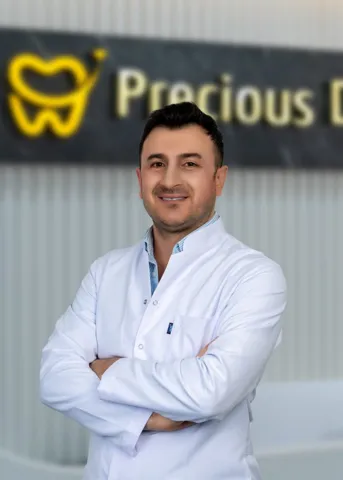 Medically reviewed by Dt. Hüseyin Yavuz Özbek, implant surgeon · Updated October 2026
Many people have slight speech changes after All-on-6, most often with S, F and TH sounds, because the tongue and lips must adapt to new teeth and a new shape behind them. A 2004 McGill University study found that speech with fixed upper implant bridges was, on average, less clear than with implant overdentures at two months, which shows why shape matters. Most people adapt within a few weeks. Persistent problems can often be improved by adjusting the bridge shape, which is one reason the temporary bridge is used to test speech.
Why new teeth change speech
Speech depends on tiny, precise movements. For an S sound, the tongue tip sits just behind the upper front teeth and air is pushed through a narrow channel. For F and V, the lower lip touches the edges of the upper front teeth. For TH, the tongue sits between the teeth. Change the position, thickness or angle of those teeth even slightly, and the sounds change.
All-on-6 changes a lot at once. The front teeth may be in a new position. The bridge has a base where it meets the gum, which is thicker than natural teeth. If you have worn an upper denture, your palate is now uncovered. If you had failing teeth, the gaps and loose teeth you were used to are gone. Your tongue, which has learned to work around the old arrangement for years, needs time to relearn.
What the research shows
A study at McGill University in Canada is one of the few to measure speech carefully with different upper implant prostheses. Thirty people without teeth, all with lower implant prostheses, tried both a fixed upper implant bridge and a removable upper implant overdenture in a crossover trial. After two months with each, recordings of test words were rated by listeners. People produced a higher percentage of consonant sounds correctly with the overdentures than with the fixed bridges; the differences were significant for stop and fricative sounds but not for vowels.
That does not mean fixed bridges cause bad speech. It shows that the shape of the prosthesis matters, and that fixed bridges, with gaps and contours underneath, need particular attention to speech. Many modern bridge designs and good planning reduce the problem. It also shows why the temporary bridge phase is so useful: it lets you and the dentist test speech before the final bridge is made.
The common changes
| What you notice | Likely cause | What can help |
|---|---|---|
| A lisp on S and Z | Tongue not yet used to the new position of the front teeth | Practice; sometimes reshaping behind the front teeth |
| A whistle on S | Air escaping through a gap under or between teeth | Adjusting the bridge base or tooth position |
| Slurred SH and CH | Thickness of the bridge behind the teeth | Practice; thinning where possible |
| Changed F and V | Lower lip meeting the upper teeth at a new point | Practice; checking front tooth length |
| Biting the tongue or cheek | New tooth positions and muscles adjusting | Usually settles; report if it continues |
| Feeling the mouth is “full” | Bulk of a new bridge | Usually fades in weeks |
How long adapting usually takes
Everyone is different, but a common pattern is:
- First few days: speech feels strange, partly because of swelling and soreness after surgery. Don't judge it yet.
- First two to three weeks: most of the adaptation happens. Others often notice less than you do.
- After a month: most people speak naturally. Any persistent lisp or whistle is worth raising with the dentist.
- Final bridge: a shorter, second period of adjustment, usually quicker because the shape is refined.
Exercises that help
The fastest way to adapt is simply to talk a lot. Some people find structured practice helps:
- Read aloudTen minutes a day from a newspaper or book. Choose passages with lots of S, F and TH sounds.
- Count slowlyFrom sixty to seventy, then from six to sixteen: lots of S and X sounds.
- Practise tricky phrases“She sells sea shells”, “fifty-five fresh fish”, “thank you for thinking of this”.
- Record yourselfOn your phone. Compare after a week; progress is often clearer on a recording than in your head.
- Talk on the phoneWithout facial cues, people focus on the sound, which gives you useful feedback.
Comparing with dentures
For many people coming from dentures, speech is one of the pleasant surprises of All-on-6. The NHS lists problems dentures can cause, including difficulty eating and speaking when they don't fit well. A loose denture can click, slip or drop when you talk, and an upper denture covers the palate, which the tongue uses as a reference point. A fixed bridge does not move and leaves the palate open. Even so, the initial adjustment is real, so expect a few weeks of practice. More on that comparison in All-on-6 vs dentures.
When to ask for an adjustment
Ask your dentist if, after three or four weeks:
- a lisp or whistle has not improved,
- you keep biting your tongue, lip or cheek,
- people regularly ask you to repeat yourself,
- you are avoiding talking because of how you sound.
Small changes to the shape of the bridge, especially behind the front teeth or where it meets the gum, can make a large difference. With the temporary bridge, this is part of the normal process and the lessons go into the design of the final bridge. With the final bridge, some changes are easier than others depending on the material.
What you can ask for at the planning stage
- Tell the dentist if your job or hobbies depend on your voice: teaching, singing, presenting, playing a wind instrument.
- Bring photos of your smile from before your teeth failed. They help the dentist place front teeth where your lips and tongue expect them.
- Ask to test speech on the temporary bridge and report what you notice, in detail.
- Ask how the underside of the final bridge will be shaped, balancing speech, appearance and cleaning.
Speech and the bigger picture
Bridge design is always a balance. A base that sits tight to the gum may be better for speech but harder to clean under; one with more space is easier to clean but can let air through. Good dentists aim for the best compromise for you, and our article on All-on-6 after gum disease explains why cleanability matters so much. Your speech priorities belong in that conversation.
Singing, wind instruments and public speaking
If you sing, play a wind instrument or speak for a living, tell your dentist before treatment. Embouchure, the way the lips and teeth shape the mouth for a brass or woodwind instrument, depends on precise front tooth position. Singers rely on space and resonance in the mouth. These activities are often possible with All-on-6, but they deserve particular attention at the planning stage, and the temporary bridge is the moment to test them. Bring your instrument to a try-in appointment if that would help.
Talking on the phone and video calls
In the first weeks, some people feel self-conscious on the phone, where listeners rely entirely on sound. It can actually be a useful practice ground, because it gives honest feedback. Video calls can feel easier, as people see your face and often do not notice small changes. Most people find that friends and family notice far less than they feared.
Speech and the final bridge
When the final bridge is fitted, there is usually a short second adjustment. The final bridge may be slimmer and harder than the temporary one, and the teeth may be in a slightly different position based on what was learned from the temporary. Expect a few days to a couple of weeks of adjustment, usually quicker than the first time.
At Precious Dental the temporary bridge is used to check how you look, bite and speak, and what we learn is used to design your final teeth. Why Precious Dental.
Common questions
How long does it take to speak normally with All-on-6?
Most people adapt within a few days to a few weeks. Reading aloud and talking a lot speeds it up. If a lisp or whistle persists beyond a month or so, ask your dentist to check the shape of the bridge.
Why do I whistle on S sounds?
Air escaping through a gap between the bridge and the gum, or a change in the position of the front teeth, can cause a whistle. Small changes to the bridge shape often fix it.
Will my speech be better than with my denture?
Many people find it is, because the bridge does not move and the palate is not covered. But the new shape still takes getting used to.
Does the final bridge sound different from the temporary one?
It can, slightly, because it may be thinner or shaped differently. The temporary bridge is used to test speech so the final one can be improved.
Are some sounds harder than others?
S, Z, F, V, SH and TH are the sounds most affected, because they depend on precise contact between the tongue, lips and teeth.
Sources
- Heydecke et al. (2004), J Dent Res — Speech with maxillary implant prostheses: ratings of articulation
- British Society of Periodontology — Patient FAQs: dental implants (fixed and removable options)
- NHS — Dentures (problems dentures can cause)
Checked October 2026. Where we give our own view as a clinic, we say so.
Ask a dentist-led team, without the sales pitch.
Tell us what you're considering. A real person replies in plain English, and will tell you honestly if All-on-6 isn't the right step for you.